Pages

.

Training course on phenotyping for abiotic stresses held for Asia and Africa scientists

IRRI's second regional training course on Phenotyping for abiotic stresses, GxE testing, seed storage, and farmer participation is ongoing at its Training Center, with 28 young rice scientists from Asia and Africa attending.

At the opening session, Bruce Tolentino, IRRI's deputy director general for communications and partnerships, underscored the significance of the course as a “merging” of IRRI’s mission and national food security goals. 

Soledad Castañeda, chief of the Atomic Research Division of the Philippine Nuclear Research Institute (PNRI), also welcomed the participants.

The course offers participants the latest in phenotyping approaches for stresses such as salinity, drought, submergence, and other soil problems; proper seed multiplication and management, and participatory approaches. It is composed of a series of lectures and hands-on exercises delivered and facilitated by resource persons from IRRI, the Food and Agriculture Organization (FAO,) and the International Atomic Energy Agency (IAEA). 

Sponsors of the training course are IAEA; the Agricultural Research Development Agency (ARDA); the Ministry of Agriculture and Cooperatives, Thailand; the Department of Agriculture and Ministry of Agriculture and Forests, Bhutan; the Stress-Tolerant Rice for Africa and South Asia (STRASA) Project; the European Commission (EC); the International Fund for Agriculture Development (IFAD); and IRRI. 

The two-week course runs from 1-12 July 2013 under the supervision of course director Abdelbagi Ismail. It is jointly facilitated by the IRRI Training Center and PNRI.


Learn more about IRRI (www.irri.org) or follow us on the social media and networks (all links down the right column).
reade more... Résuméabuiyad

Nepal celebrates National Rice Day

Nepal celebrated its 10th National Rice Day on 29 June 2013, with more than 10,000 government and agriculture leaders, researchers, extension workers, and farmers joining the festivities held at farmers’ fields in Bhaktapur District and at the Nepal Agricultural Research Council (NARC) Research Centre in Khumaltar.

Tek Thapa and Jaya Mukunda Khanal, the minister of agriculture development (MoAD) and MoAD secretary, respectively, emphasized adoption of rice technologies to increase production and productivity for food security in their messages.

Several rice production technologies were highlighted by Dil Gurung, NARC executive director, who also cited the Nepali government's support to rice research through supply of genetic materials; technological development; capacity building of rice scientists; and Nepal's participation in various partner networks based at IRRI that include the Consortium for Unfavorable Environments (CURE), Council for Partnership on Rice Research in Asia, Hybrid Rice Development Consortium (HRDC), and the Temperate Rice Research Consortium (TRRC).

The IRRI Nepal Office was represented by Bhaba Tripathi in the ceremonies.

From 2004, when Nepal joined the United Nation's call to celebrate the International Year of Rice, the government decided to celebrate National Rice Day on 29 June every year.

National Rice Day aims to make people aware of the importance of rice to the national economy as well as in daily life.

The IRRI Nepal Office was represented by Bhaba Tripathi in the ceremonies.


Learn more about IRRI (www.irri.org) or follow us on the social media and networks (all links down the right column).
reade more... Résuméabuiyad

Israeli breeding firm partners with IRRI

Kaiima Bio-Agritech, an Israel-based seed and breeding technology company, and IRRI have announced their partnership to develop new rice varieties. 

The partnership combines IRRI and Kaiima’s expertise in breeding and technology for the development of high-yielding rice hybrids and breeding lines. Through it, the two parties aim to breed new rice varieties with significantly more biomass and higher grain yield while maintaining a high level of important quality parameters.

”We are delighted to partner with IRRI, a world leading organization in rice breeding," said Doron Gal, CEO of Kaiima. "Applying Kaiima technology to IRRI’s elite genetic material can create a breakthrough in the yield and climatic adaptability of this key global crop."

"The newly developed varieties will allow us to improve yield stability for rice farmers in a sustainable manner and help address food security for years to come," Dr. Gal added.


Learn more about IRRI (www.irri.org) or follow us on the social media and networks (all links down the right column).
reade more... Résuméabuiyad

Cambodia: Postharvest project assesses outcomes

Seventy-eight partners of the ADB-IRRI Postharvest Project from Cambodia, Vietnam, and the Philippines met in Battambang, Cambodia, on 19 June for the International Seminar on Reducing Rice Postharvest Losses, funded by the Asian Development Bank.

Partners, who come from the government, the private sector, IRRI, and nongovernment organizations (NGOs), reported on the milestones and outcomes from adaptive research, technology promotion, and participatory approaches of the project.

Initial results from a case study of technology adoption by farmers in Cambodia were also presented, showing indicators of benefits.

Project outcomes in the three countries were impressive, with combine harvesting having been established in Cambodia, flat-bed dryers introduced in Cambodia and the Philippines, hermetic storage systems increasingly being sold, and laser-leveling gaining traction in Cambodia and Vietnam.

Partners then discussed remaining activities and outlined new challenges to postharvest loss reduction and the ways toward addressing these. The project will close in October 2013.

A half-day cross-learning event was held prior to the seminar, on 18 June, where 200 participants including Learning Alliance members, key representatives from institutions and policy, and 92 farmers visited three sites representing different players of the postharvest value chain: a farmer cooperative that provides drying services and demonstrated simple granary improvements; a large-scale miller who exports rice and uses both modern and flatbed dryers; and a rice demonstration farm at the Don Bosco School where a flat bed dryer, hermetic storage, a rice mill, laser-leveled fields, and other equipment for mechanization was showcased.

Don Bosco operates several technical schools and is introducing in its curriculum agricultural machinery mechanics, with assistance from the project.

Martin Gummert, project leader, said that the challenge of postharvest losses continues to increase as countries intensify rice production, which results in more and wetter paddy entering often antiquated postharvest systems.

“Our project partners have had tremendous success in introducing new technologies,“ said Dr. Gummert. “More than 200 of the dryers introduced through the project are now in use in Cambodia. In Cambodia and Vietnam, partners have started developing the next generation of drying technology. Laser-leveling is also picking up, and hermetic storage solutions are increasingly being used."

But the job is far from finished, said Dr. Gummert, who is also IRRI's postharvest specialist. "New problems arose with the introduction of some of the technologies, and the improper use of combine harvesters, for example, have caused excessive losses," he said. "We are committed to continue working with our partner countries in addressing these challenges, and continue helping create success stories by considering some of these outcomes in new projects and by influencing policy.”


Learn more about IRRI (www.irri.org) or follow us on the social media and networks (all links down the right column).
reade more... Résuméabuiyad

IRRI rep to Lao PDR is guest in researchers lunch

Ben Samson (third from right), IRRI representative to
Lao PDR, with some of IRRI's young scientists.
The Young Researchers Lunch for June hosted Ben Samson, agronomist and IRRI representative to Lao PDR.

Dr. Samson described the upland rice-growing environment and answered questions about challenges that farmers in Southeast Asia face.
He also shared the interesting story of his career path, which started out as "retirement first" as part of a dual-career family before he started his work with IRRI in Laos.

Participants of the June lunch were Tahir Awan, Ebna Rashid, Anshuman Singh, Judith Dela Torre, and Kharla Mendez.

The Young Researchers Lunch is a monthly meeting of IRRI scientists who are in the early stages of their career. Its aim is to provide an opportunity for discussion with senior scientists on a range of topics in science, and career paths.


Learn more about IRRI (www.irri.org) or follow us on the social media and networks (all links down the right column).
reade more... Résuméabuiyad

IRRI celebrates Philippine Independence

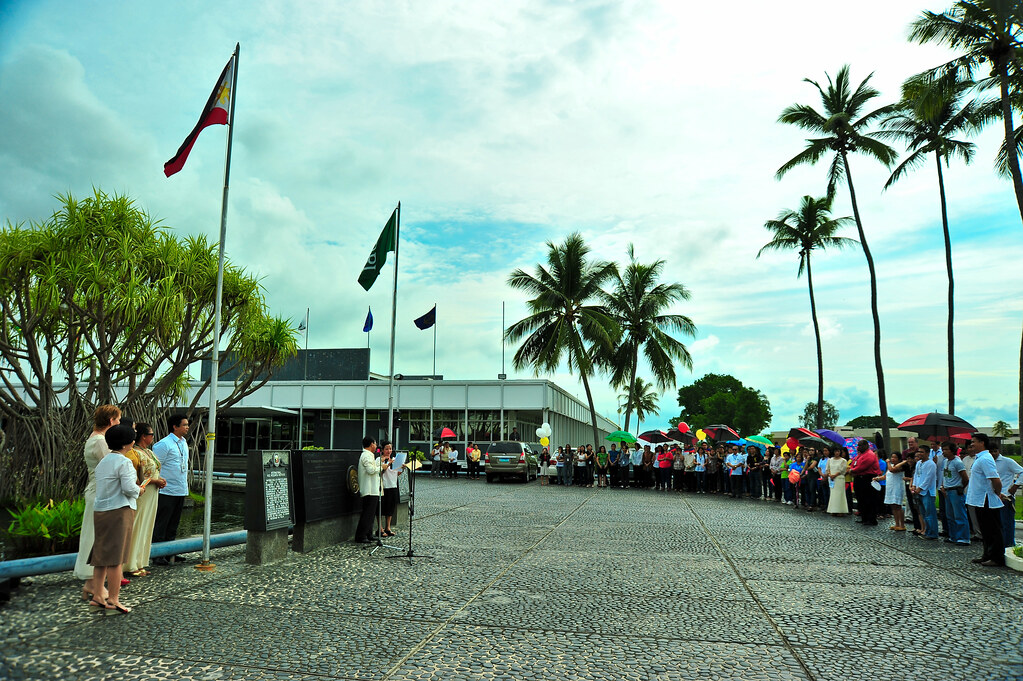
With a simple flag-raising ceremony, IRRI commemorated the 115th  year of Philippine independence at its headquarters on 11 June 2013. Photos


The activity opened with messages from Corinta Guerta, IRRI's external relations director, and Cesar Perez, vice governor of Laguna Province and incoming mayor of Los Baños. The vice governor was represented by Genalyn Serrano, his chief of staff who delivered the message on his behalf.

Members of IRRI management and staff gathered at the main rotunda  in front of F.F. Hill to take part in the ceremony, in solidarity with the Filipino nation, as they released balloons as a symbol of freedom while singing Ako ay Pilipino (I am Filipino).

The activity was organized by the Society of IRRI Non-research Professionals, in coordination with other sectoral organizations in the Institute and the Human Resource Services.


Learn more about IRRI (www.irri.org) or follow us on the social media and networks (all links down the right column).
reade more... Résuméabuiyad
Young scientists take on multifaceted climate change project

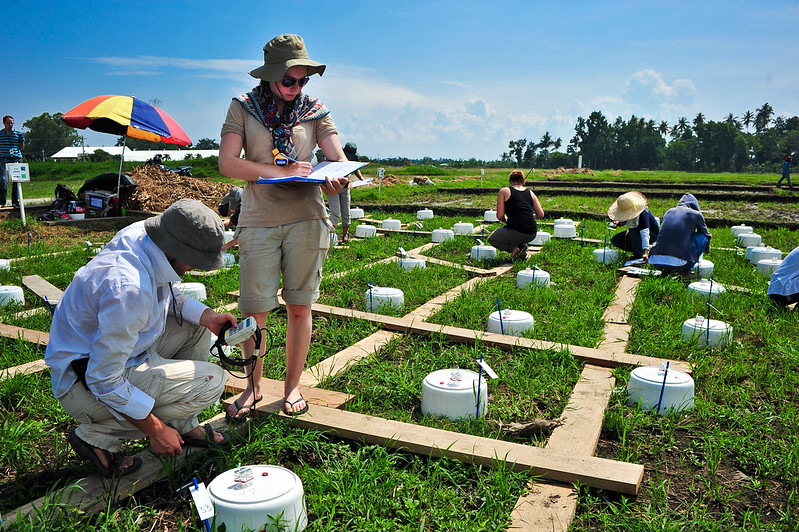
From fields as diverse as hydrology, zoology, and modeling, five Ph.D. students measured greenhouse gas emissions and gathered biological, hydrological, and soil-related data as part of the Impact on Carbon, Nitrogen, and Water Budgets (ICON) project.

The students were interested to see if a significant difference existed among those parameters within small fields, which could greatly improve modeling and upscaling of any technology.

"Pictures from the sampling day, when we were doing soil gas measurements, give an impression of how demanding the simultaneous measurement of 64 points can be,” said Sebastian Weller, one of the students involved in the project.

Data was gathered from 64 plots, each measuring 1.4 square meters.  Nearly 1,300 analyses will be made from the entire collection of field data.

"We lost a lot of sweat after a hot day in the field, but gained insight into one another's work and the possibility for knowledge exchange and sharing of experiences,” said David Kraus, also a student.

As soon as analyses are complete, the students will publish their results to include those of other participating research groups. 

The ICON project is supported by the German Research Foundation (DFG) and involves five German research facilities and IRRI.

ICON aims primarily to explore the ecological consequences of future changes in rice production in Southeast Asia by looking at shifts in flooding regimes (flooded vs. non-flooded), crop diversification (wet rice vs. dry rice vs. maize) and various crop management strategies, such as nitrogen fertilizer use.


Learn more about IRRI (www.irri.org) or follow us on the social media and networks (all links down the right column).
reade more... Résuméabuiyad